


- Datapunkt Intelligence
- Hits: 395
Data Modeling Agent
In today’s data landscape, systems must scale effectively regardless of the number of sources and growing business expectations. Yet traditional data platforms struggle to scale with complexity. When manual engineering and human coordination are required, processes often stall due to inconsistencies, duplicated effort, and – growing frustration.
Recognizing this limitation, Datapunkt created an intelligent agentic layer designed to absorb complexity instead of pushing it onto people. With this layer in place, a data platform no longer merely stores data – it understands, acts, and continuously improves itself.
In this article, we explore the Data Modeling Agent – the semantic and structural authority behind the Datapunkt agentic ecosystem. We focus on its core functions, business benefits, and what makes it a true game-changer in modern data modeling.
Multi-Agent Architecture and Collaboration
The Datapunkt agentic layer is an intelligent ecosystem, where specialized agents perform a wide range of data-related tasks. Managed by a Root Orchestrator, the agents share context, align decisions, and respond to one another’s outputs – much like members of a well-run team would.
So, where does the Modeling Agent fit within this hierarchy?
What Is the Datapunkt Data Modeling Agent?
A Modeling Agent is an autonomous software agent designed specifically to handle tasks around data modeling. Within the Datapunkt coordinated agentic suite, it serves as the authoritative source of truth for data structure and semantics. The agent defines raw, curated, and consumption-level data models, including entities, relationships, and business meaning.
The diagram below depicts core responsibilities of the Modeling Agent.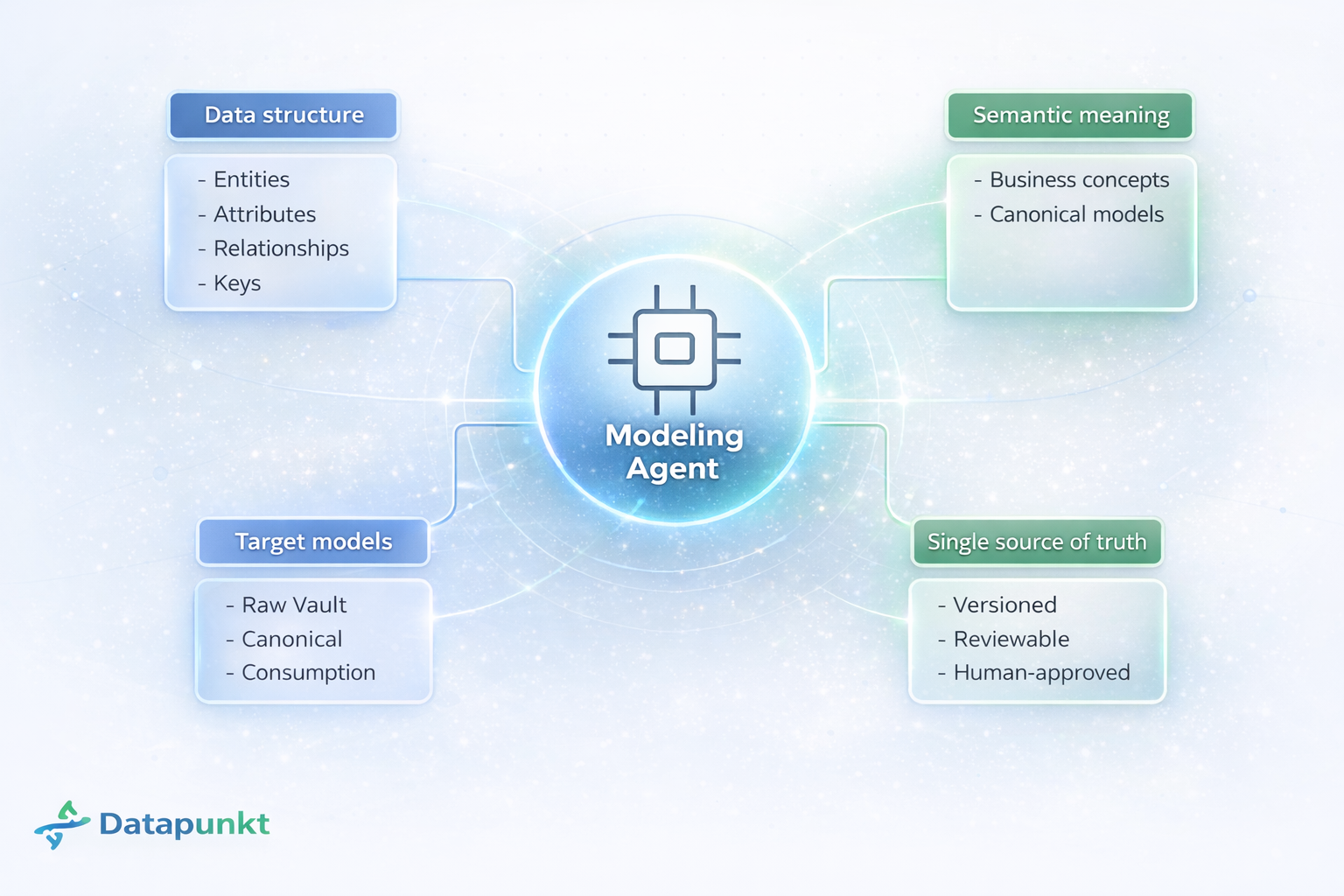
Raw Vault Data Modeling
Raw Vault modeling is an important part of modern data architectures. By storing raw source data exactly as it arrives, a Data Vault serves as a stable archive of truth ensuring auditability, traceability and compliance.
Despite its strategic importance, Raw Vault modeling is notoriously hard to implement: it takes months to design and requires rare specialists. The largely manual nature of this work makes it extremely error-prone. In most organizations, there is no single intelligent system that understands the full data landscape and enforces consistency across all layers.
The Datapunkt Modeling Agent overcomes these limitations by combining automation with intelligence. Understanding both the structure and meaning of incoming data, the agent automatically analyzes source systems, performs semantic integration, and handles lineage and auditability by design. As a result, Raw Vault models that once took months to build can now be generated in minutes. Afterwards, these models are continuously maintained and aligned through collaboration with other specialized agents in the Datapunkt ecosystem.
Curated Data Modeling
Canonical data models are a key component of different industry standards. These models define key business concepts and their relationships within a specific industry – retail, energy, manufacturing or telecom – ensuring that all systems there speak the same language. Banking Industry Architecture Network (BIAN) is a good example of such an industry-specific canonical model.
As a business architecture-driven standard, BIAN defines thousands of banking business entities along with deeply nested relationships and strict semantic rules. Due to the sheer number of interconnected concepts, BIAN models are highly complex and difficult for humans to build and maintain – but not for machines that thrive on this level of complexity.
The Modeling Agent understands BIAN as a graph, where domains, concepts, and relationships are represented as a connected network. This graph-based knowledge allows the agent to automatically traverse and reason over complex banking structures, while scaling seamlessly across domains. As a result, banking data models can be created quickly and accurately, with all required relationships in place, without manual effort.
Consumption Modeling
When organizations reach the consumption layer – analytics, BI, reporting – they often struggle with the lack of a shared understanding of what makes consumption-ready data. Each team builds its own views and defines its own metrics, which leads to conflicting models and inconsistent business definitions.
By employing the Modeling Agent, organizations can overcome this inconsistency and eliminate repeated manual modeling. The agent defines consumption-ready models once, makes them reusable, and keeps them aligned with upstream changes. By enforcing consistent semantics and business meaning, it accelerates the delivery of new use cases and enables a smoother, highly automated path from data to insight.
Core Capabilities of the Modeling Agent
Prompt-driven modeling. Data modeling no longer requires drawing diagrams or writing specifications. Simply describe the desired outcome in natural language – say, by specifying the question that the business wants to be answered – and the Modeling Agent will generate the model automatically.
Embedded expertise. As manual data engineering struggles to keep pace with growing complexity, the Modeling Agent brings built-in domain expertise across multiple industries. It incorporates industry standards and canonical models, enabling automatic mapping of raw data into these established frameworks.
Human-in-the-loop by design. In Datapunkt workflows, humans remain in control while AI acts as an assistant. The Modeling Agent supports enterprise-safe processes where results can be reviewed, corrected, and explicitly approved by humans.
Omnimodal intelligence. The Modeling Agent can consume information in multiple forms, including structured data, conversations, documents, and visual inputs. Regardless of the input mode, it produces consistent and effective data models.
Continuous learning. The agent continuously improves through interaction. It retains contextual knowledge from previous conversations and understands evolving requirements, ensuring that insights and decisions are never lost and that modeling accuracy improves over time.
Conclusion
The Datapunkt Modeling Agent represents a fundamental shift in how data modeling is approached. Embedded within an intelligent agentic ecosystem, it automates the most complex and error-prone aspects of modeling while preserving human oversight and trust. From Raw Data Vault generation to industry-standard canonical models and consumption-ready semantic layers, the agent brings structure, meaning, and consistency to every stage of the data lifecycle.