- Vadym Humeniuk - Resident Architect
- Datapunkt MPP
- Hits: 550
Datapunkt's Massively Parallel Processing Engine

Introduction
Datapunkt Massive Parallel Processing (MPP) revolutionizes data processing with its innovative architecture designed to handle large-scale SQL queries efficiently. Unlike traditional approaches, Datapunkt MPP leverages parallel processing across a distributed cluster of nodes to deliver superior performance and scalability.
Datapunkt MPP Overview
Leveraging this architecture, the Datapunkt query engine is able to process SQL queries on large amounts of data in parallel across a cluster of computers, or nodes. Datapunkt MPP runs as a single-server process on each node. Multiple nodes running Datapunkt Engine, which are configured to collaborate with each other, make up a Datapunkt cluster.
Figure below displays a high-level overview of a Datapunkt cluster composed of one coordinator and multiple worker nodes. A Datapunkt user connects to the coordinator with a client, such as a tool using the JDBC driver or the Datapunkt CLI. The coordinator then collaborates with the workers, which access the data sources.
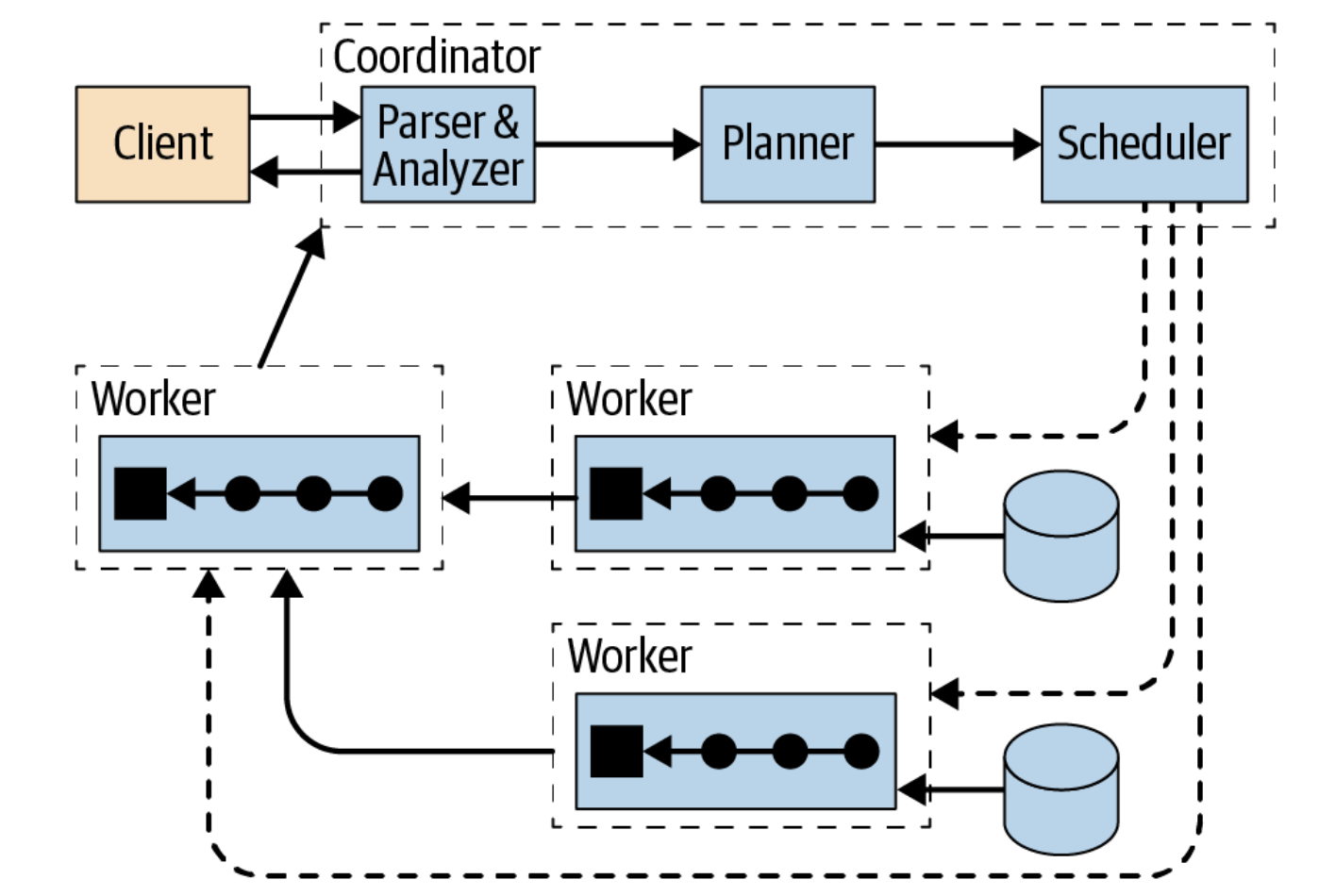
- A coordinator in Datapunkt MPP is a server responsible for handling incoming queries and orchestrating the execution of tasks across the worker nodes.
- Conversely, a worker in Datapunkt MPP is a server tasked with executing assigned tasks and processing data.
- The discovery service, typically hosted on the coordinator node, facilitates worker registration and participation within the cluster.
- Communication and data transfer between clients, coordinator, and workers in Datapunkt MPP rely on REST-based interactions over HTTP/HTTPS protocols.
Datapunkt MPP employs a variety of splitting strategies tailored to the characteristics of the data source and query type. These strategies include:
- Range-based splitting: Segments data into ranges, such as date ranges for time-series data, to enable parallel processing.
- Hash-based splitting: Distributes data based on hash values to ensure consistent distribution, regardless of changes in data order.
- Bucketing splitting: Groups data into "buckets" based on specific column values, facilitating efficient joins and aggregations.
Distinct distribution strategies are employed for different join algorithms in Datapunkt MPP:
- Broadcast joins: Distribute smaller datasets to all workers to optimize processing efficiency, particularly when one input is substantially smaller than the other.
- Shuffle joins: Exchange and shuffle data across workers based on join keys, enabling efficient processing for larger datasets by ensuring data distribution across the cluster.
Data Locality Optimization
Data locality optimization lies at the core of Datapunkt MPP's performance optimization strategy. By prioritizing worker proximity to data storage, Datapunkt MPP minimizes network latency and maximizes throughput, particularly in geographically distributed environments. Through intelligent data placement and routing algorithms, Datapunkt MPP ensures that data processing tasks are executed with optimal efficiency, delivering lightning-fast query performance and unparalleled user experience.
Concurrency Mechanisms
Datapunkt MPP splits queries into logical stages, each responsible for a specific data processing step (e.g., filtering, joining, aggregating). Stages execute concurrently within a query. Different stages can execute concurrently across multiple workers, significantly boosting performance compared to a single-threaded approach. Optimizations applied to individual stages can benefit the entire query.
Within each stage, operators (e.g., filter, join) process data in a pipelined fashion, sending results downstream as they become available. This eliminates waiting for the entire upstream data to be processed before starting downstream operations. Imagine operators as the workers within each stage, responsible for specific data processing tasks (e.g.,filtering rows, comparing values). Operators don't wait for the entire upstream data to be processed before starting. Instead, they process data in chunks and send results downstream as they become available. This pipelined approach eliminates idle time and dramatically improves query execution speed.
Datapunkt MPP dynamically adjusts the number of concurrent stages and operators based on available worker resources and workload characteristics. This ensures efficient resource utilization and avoids overloading the system.
- Datapunkt MPP doesn't run with a fixed number of stages and operators. It adapts dynamically based on:
- Available worker resources: Number of CPUs, memory, and network bandwidth.
- Workload characteristics: Data size, query complexity, and resource requirements of each stage.
- Scaling Up: When resources are available and necessary, Datapunkt MPP can increase the number of concurrent stages and operators to handle the workload efficiently.
- Scaling Down: Conversely, it can reduce resource usage when demand decreases, avoiding unnecessary overhead.
- Importance of Monitoring: By monitoring resource utilization and query execution details, you can fine-tune Datapunkt MPP's dynamic scaling behavior for optimal performance in your specific environment.
Query Results Caching
Datapunkt MPP offers different caching levels with varying trade-offs in terms of performance, scalability, and persistence:
- Local Caching: Caches results within individual workers, enabling fast reuse within the same query execution. Useful for temporary intermediate results.
- Shared Caching: Stores results in a shared in-memory cache accessible by all workers. Ideal for frequently accessed data or subqueries across multiple queries.
- Disk Caching: Persists results on distributed storage, enabling reuse across different sessions and potentially long-term data access. Suitable for frequently used, large datasets.
Datapunkt MPP does also employ various mechanisms to ensure cache consistency and data freshness:
- Partition-based invalidation: Invalidates cached results associated with specific data partitions that have been updated.
- Time-based expiration: Sets expiration times for cached entries to ensure automatic removal of stale data.
- Manual invalidation: Allows explicit invalidation of cached results when necessary.
Datapunkt MPP might cache the result locally on each worker for efficient reuse within the same query execution. Additionally, it could store the result in the shared cache for potential reuse by other queries accessing the same data. If the table is updated, Datapunkt MPP would invalidate the cached entries using partition-based invalidation to ensure consistency.
Conclusion
In conclusion, Datapunkt Massive Parallel Processing (MPP) represents a quantum leap in data processing technology, offering organizations unprecedented capabilities to unlock the full potential of their data assets. With its innovative architecture, advanced splitting strategies, optimized join algorithms, data locality optimization, dynamic concurrency mechanisms, and comprehensive caching mechanisms, Datapunkt MPP stands as a cornerstone solution for modern data-intensive applications, enabling organizations to extract actionable insights and drive informed decision-making at scale.